
It was May 1986 when, on a radio call from the kitchen of a Melbourne function centre, Paul Keating warned that Australia was at risk of becoming a ‘banana republic’. Keating’s fear, as Treasurer, was that Australia could become increasingly dependent on exporting raw commodities, unable to compete in value-add manufacturing, forced to continually borrow from overseas, and thereby suffer from a steady decline in living standards. What’s changed? This year is the 40 year anniversary of this famous remark.
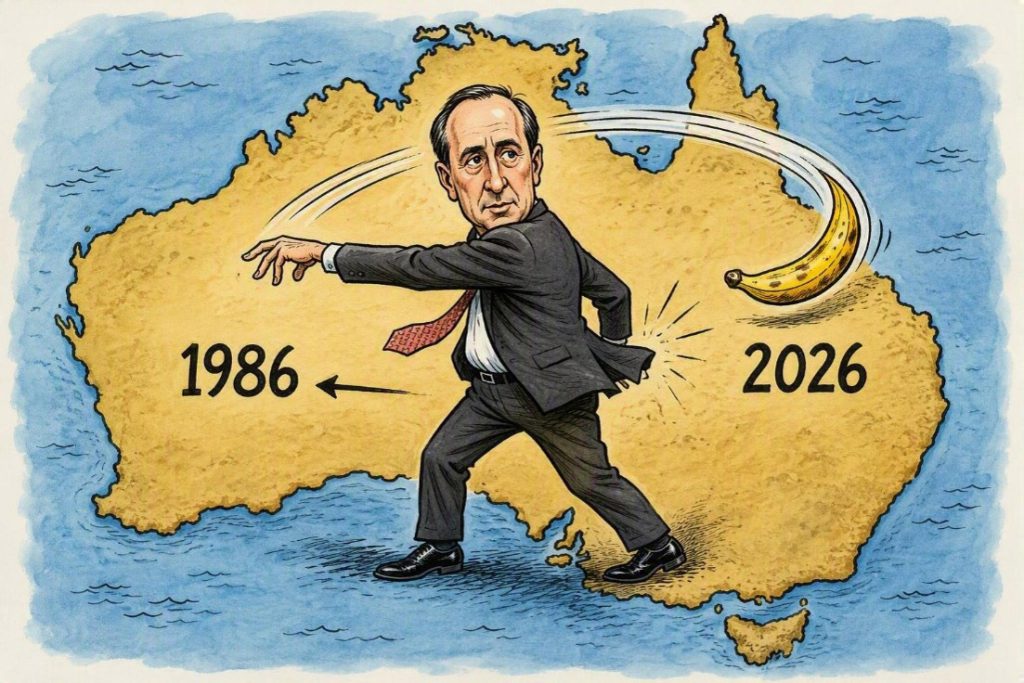
At the time, Australia had a significant current account deficit, declining terms of trade and there was genuine fear that the country would become uncompetitive internationally. Some may have thought the description was alarmist, but what followed was some of Australia’s most transformational, courageous and necessary financial reforms in its history.
Despite the economic challenges and relatively high taxes of the time, in 1986 Barry Mendel was 5 years into building BMF. Starting from nothing more than a small office in the MLC Centre with nothing to back him except a vision to offer exceptional, personalised service, a strong South African work ethic and an Australian ethos of having a ‘fair go’, the business was driven by opportunity and, dare we say it in today’s times, capitalism.
It appeared that while Australia was in the difficult economic position that required substantial economic reform, there was opportunity and incentive for the person on the street to build a business, invest in yourself and your country and be rewarded with an acceptable return for the risk taken and the time sacrificed. It was not without its challenges but this trend continued across Australia for decades.
A couple of generations later however, there is a sense that the banana has swung around like a boomerang where living standards are declining and ambition and risk taking are being discouraged or penalised in the name of housing affordability.
The problem of housing affordability could have its own deep dive. It’s almost universally agreed that the cost of housing in Australia is out of reach for the current and next generations (without outside help). While this issue is not unique to Australia (it’s a common theme in other developed nations), there is a real possibility that Australia is at risk of a brain drain with skilled, educated, young talent moving overseas in the name of affordability and opportunity. The gap between the have’s and the have nots has widened and years of central bank and government mismanagement has caused asset price inflation to significantly outpace wage growth. Of course, there were also global factors outside of Australia’s control and this story is not unique to us, but rather a more recent phenomenon compared with other countries.
Nevertheless, rather than helping the next generation it appears that they are being kicked out of the race altogether. As a 20 year old, I invested some of my (already taxed) employment earnings in the share market to start my wealth journey. I took risk. Any capital gain was taxed at my marginal rate which was very much in the lowest tax brackets. A long term gain was discounted by 50% for tax purposes. If my income was below the tax-free threshold, I paid no tax. It helped.
From 1 July 2027, a 20 year old risking their (already taxed) earnings to start their wealth journey will be taxed a minimum rate of 30% on capital gains irrespective of their income tax rate. While there may be some minor tax offsets to reduce this, it is still a top 10 capital gains tax rate amongst OECD countries. The next generation’s ability to build wealth via investments is now therefore also becoming out of reach. On top of this, recent data from NAB has revealed that if you were born in the 1990s, you are the first generation in 40 years (that magic number again) to miss out on substantially higher incomes than previous generations.
But this doesn’t really touch the crux of the problem in Australia. While we are a resource rich economy with an enviable lifestyle, Australia is a low productivity, low manufacturing, low (or negative) GDP per capita, high tax, rising debt economy.
The practical consequence for investors is that diversification beyond Australia has become increasingly important.
Take for example the following economic data:
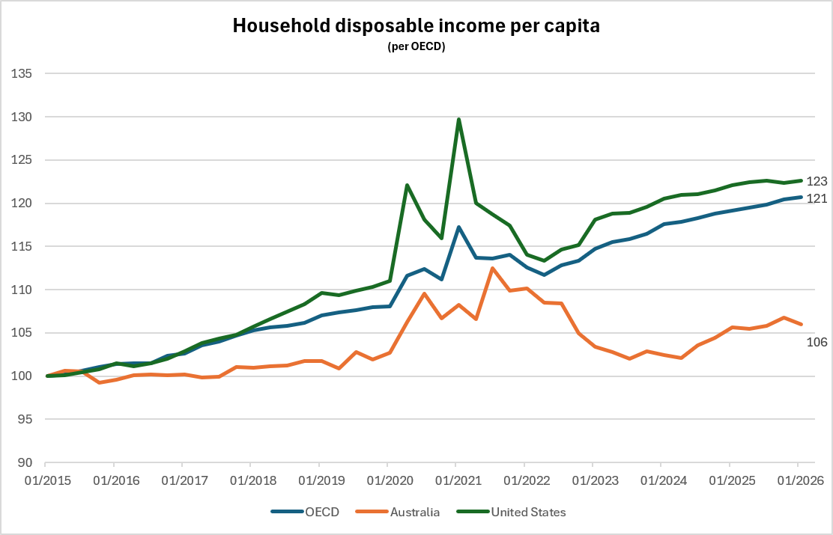
1. Since 2015, per the OECD, real disposable income in Australia has risen by merely approx. 6% compared with the OECD of almost 21%, led by the USA at 23%.
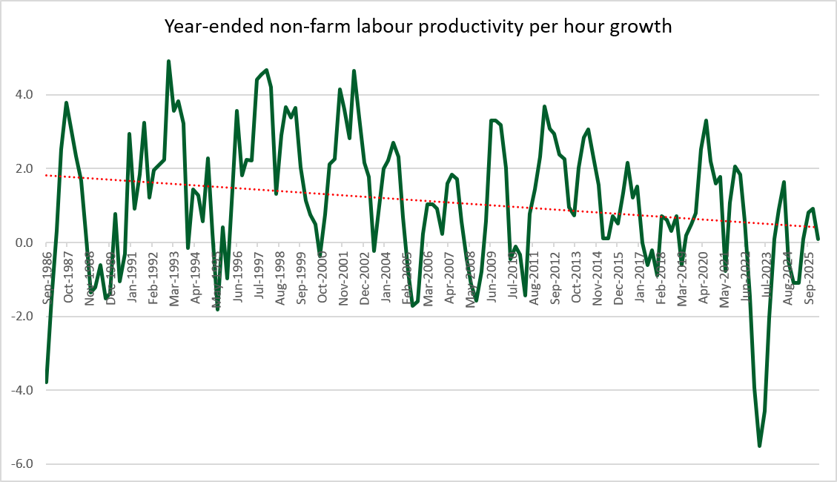
2. Per the Australian Bureau of Statistics, productivity growth for the past 2 years (ending 31 March 2026) has averaged a mere 0.1% per quarter and for the past 3 years has declined by an average of -0.4% per quarter (or a cumulative decline of almost 5%).
3. Manufacturing jobs in Australia are now just over a 5% share of total GDP compared with nearly 30% in the 1960s.
4. According to the AFR and Trading Economics, the inflation rate in Australia ranks the 2nd highest of Advanced Economies, second only to Iceland.
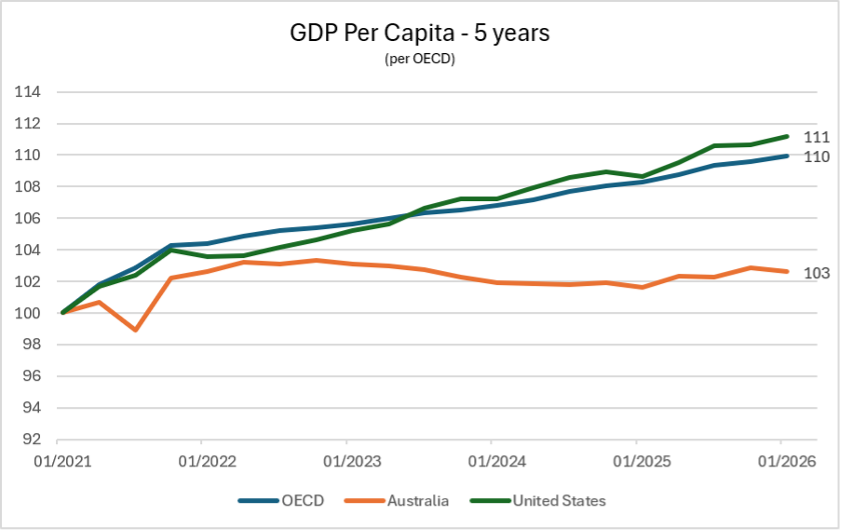
5. Going back from Menzies to the end of the Morrison government, every government produced a positive Real GDP per Capita during their time in power. This trend did not deviate whether a Liberal or Labor government. The current government is the first since WW2 where Real GDP per Capita has declined (per ABS). It’s not a technical recession but it’s a recession nonetheless.
6. Dwelling completions per 100,000 people are at the lowest rate in at least 40 years.
7. The Australian stock market is about a third financials (think banks and insurance companies), a quarter resource companies and approx. 1-2% technology companies compared with the USA of 37% technology companies, 12% financials and 2% resources.
8. For a country of just ~28 million people, and an economy of approx. $2.85 trillion (tn), we have just reached $1tn in federal government debt or $1.7tn when including State debt. All sides have contributed to this over the past 20 years.
Without productivity growth, innovation incentives, risk incentives, reform to bankruptcy laws, a fairer and more competitive tax system for all and reigning in a misallocation of government resources, the viability of Australia as an investible destination with a competitive business sector is now being questioned the most in decades. In fact, it was former Prime Minister Bob Hawke himself who in 1987 explained that to be internationally competitive, his government had to cut spending and reduce taxes for individuals and businesses.
Adding to the economic paralysis, our tax environment has become so complex and uncertain, it has become incredibly difficult for business and families to structure themselves appropriately for the future and pull the trigger to build. It’s good times for accountants and tax lawyers, but this uncertainty is causing the country to come to a standstill with capital allocators holding back and waiting for more certainty. Greater clarity will unlock this uncertainty but with a divided political environment by historical standards, this may be some time away.
So why is this important?
It’s no secret that BMF Wealth has always explored investing offshore. We have done so for decades when most were not thinking about it. At only 2% of global share markets, Australia is a mere drop in the ocean and the opportunities overseas are simply too overwhelming to be ignored. Simply think about the day-to-day products you may use and where they originate from.
Apart from our conviction in gold and resource stocks (many of which are located in Australia and operate under a strong corporate governance environment), we are encouraging clients to invest even more offshore via shares, internationally focussed managed funds and, for those where it makes sense, to open offshore banking platforms. Some of these investments are so innovative, so significant on a global scale that the local politics of their home country cannot dramatically alter their direction.
The vast opportunities to diversify across sector, jurisdiction & custodian and gain access to investments which are either not available in Australia or not easily accessible by most, is key to providing clients with a greater return and lower volatility in a very uncertain world.
With the new tax policy in Australia, there is now also more of an incentive to be investing in offshore managed funds which are structured correctly. These have always existed and have been accessible but the incentive to head in this direction is now material enough to warrant a consideration.
Let’s not be mistaken. We are pro-Australia. We want it to succeed beyond all possibilities. We remain invested in Australian investments across private credit, property, resource stocks, gold and some venture capital and will continue to invest opportunistically. However, as stewards of our clients’ wealth, we have the responsibility to protect it from pernicious policy.
Australia has never lacked talent, ambition or opportunity. While challenges undoubtedly lie ahead, history suggests that our nation’s capacity to adapt, innovate and prosper should never be underestimated. Despite what has been outlined above, we have to remain optimistic about Australia’s future and the opportunities that will emerge for those prepared to embrace them.
Disclaimer
This publication has been prepared by BMF Asset Management Pty Limited (ACN 092 277 971, AFSL 224035), to provide you with general information only. In preparing it, we did not take into account the investment objectives, financial situation, or particular needs of any person. It is not intended to take the place of professional advice and you should not take action on specific issues in reliance on this information without consulting us or your financial adviser.

About The Author
Brad Mendel
Brad specialises in global portfolio management, investment analysis and family office services. He joined the BMF Wealth team in 2011 for two years before embarking to New York. Brad spent 3 years in New York where he worked as a Private Wealth Advisor with Morgan Stanley Private Wealth Management’s ‘Team Global’. Prior to his start at BMF, he was at PwC in their Private Clients Tax team serving High Net Worth families. Brad has a Bachelor of Commerce from UNSW and is a member of the Institute of Chartered Accountants Australia. He is a member of the Investment Committee.
Most Popular Posts

20 September 2024




24 April 2023